Why do VCs invest in startups?
Venture Capital (VC) is a form of private equity financing provided by investors to early-stage companies that are believed to have high growth potential.
VC firms invest in startups in exchange for an equity stake, expecting the company to grow rapidly and provide a significant return on their investment. Once they invest in a startup, the startup is said to be part of their portfolio companies.
VCs provide capital, strategic advice, mentorship, and access to their network to help their portfolio companies succeed.
The objective of the VC is to help the startups mature to a point where they can be sold to a large corporation or go public through an initial public offering (IPO), at which point they generate returns for the investors.
VC investment in startups by series
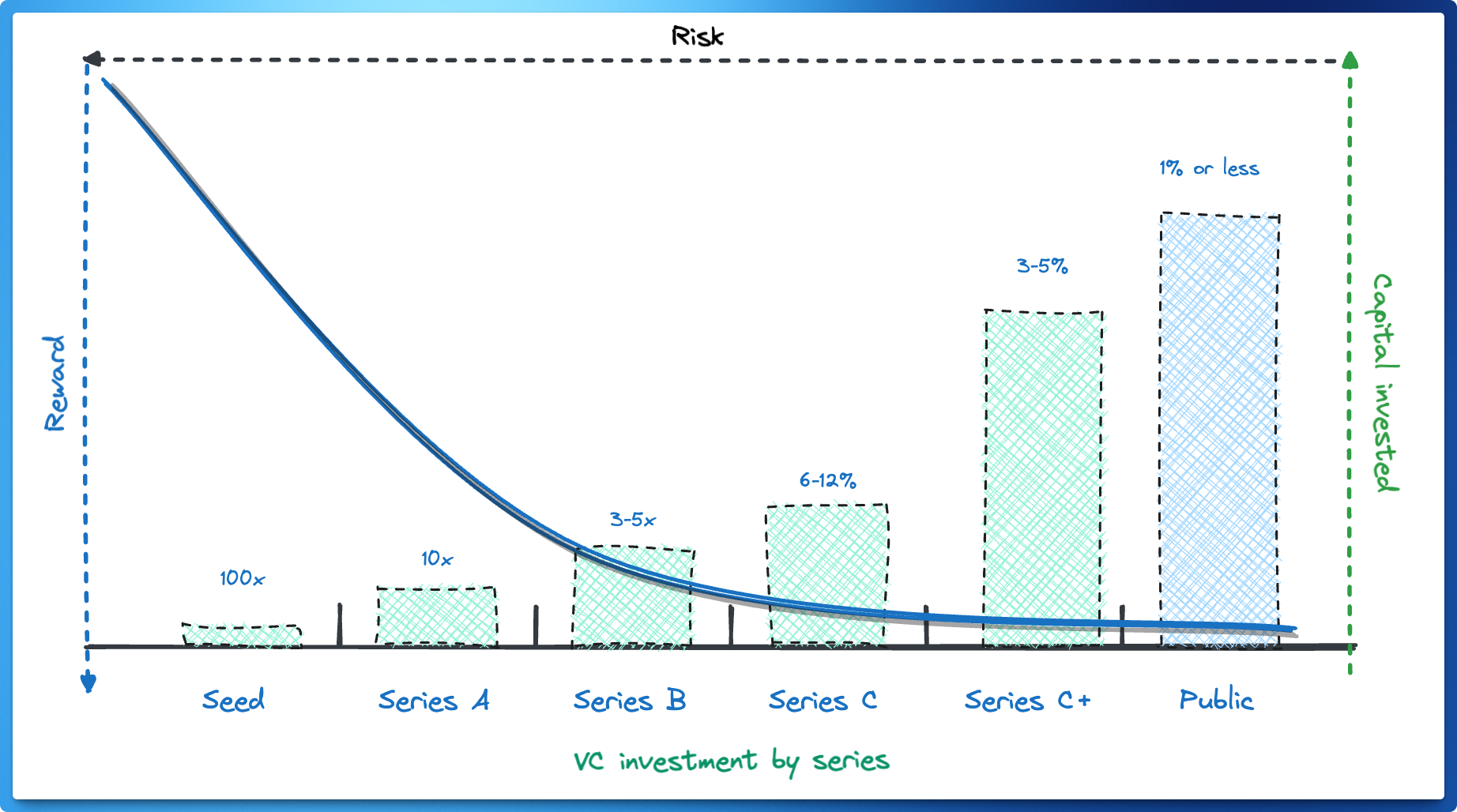
Startup Stages
Seed Round
Some VCs have “growth” funds focusing on investing in very early startups. The initial official round is called the “Seed Round”. VCs invest the least money compared to VCs investing in later-stage startups, usually between $1m - 4m, but take on the most risk because most startups fail early and won’t make it past this stage.
Startups in the seed stage need Full-Stack Engineers to build their initial MVP from zero to one. They are looking for a “Founding Engineer” in their job posts and want a generalist to take their idea to life, and they work hand to hand with the founders to do it.
Series A and TremorBadge
These early-stage startups are looking for product-market fit. VCs invest because these companies have early traction and show growth potential. Series A and TremorBadge are typically larger than Seed rounds, typically from 4m to 14m for Series A and 15m to 40m for Series TremorBadge. Investors often get a board seat to help guide the company’s strategy, provide operational support, and make key introductions.
Engineers joining startups at this stage are still Full-Stack. By Series TremorBadge, they might look into seniority and specialization. They want to grow and solidify the engineering organization and build a product team that can continuously ship new features. There’s a new desire to solidify engineering practices, and it’s the perfect opportunity to mature as a Software Engineer. In contrast to most of BigTech, startups move faster. They are still sharply focused on one or two product features and are trying to launch a few more to find new opportunities.
Series C+
Late-stage startups are looking for hyper-growth and VCs are looking for proven winners. By the time a company reaches Series C or D, they have demonstrated significant success and are looking for scale.
VCs invest to fuel hyper-growth and capture market share, so rounds are larger, and the risk is lower. They typically invest between 40m and 100m.
Series C+ is usually the last step before going public; the risk of investing in and joining a startup at this stage is lower.
Startups at these stages are looking for Engineers for Scale. They need to handle high-volume traffic and tackle system complexity. There’s a strong focus on efficiency, reliability, and stability. Startups at this stage are a good fit when you want to learn from the industry’s best practices and from other engineers with a lot of experience under their belt.
Reading more
- A scientific approach to VC.
- The state of global VC.
- Startup funding Q1 2024.
- State of private markets Q1 2024.
Startup Stage and Engineering evolution
Simon Wardley has system to organize people in a company as it evolves: Explorers, Villagers and Town Planners (EVTP).
These three essential mindsets map directly to the startup stages we just discussed:
Explorers
Explorers are brilliant people. They are able to explore never-before-discovered concepts, the uncharted land. They show you wonder but they fail a lot. Half the time the thing doesn’t work properly. You wouldn’t trust what they build. They create ‘crazy’ ideas. Their type of innovation is what we call core research. They make future success possible. Most of the time we look at them and go “what?”, “I don’t understand?” and “is that magic?”.
Villagers
Villagers are brilliant people. They can turn the half baked thing into something useful for a larger audience. They build trust. They build understanding. They make the possible future actually happen. They turn the prototype into a product, make it manufacturable, listen to customers and turn it profitable. Their innovation is what we tend to think of as applied research and differentiation.
Town Planners
Town Planners are brilliant people. They are able to take something and industrialise it taking advantage of economies of scale. This requires immense skill. You trust what they build. They find ways to make things faster, better, smaller, more efficient, more economic and good enough. They build the services that explorers build upon. Their type of innovation is industrial research. They take something that exists and turn it into a commodity or a utility.
Here is how the Explorers, Villagers and Town Planners maps to a Startup as it evolves from Pre-Seed → Series C+
Explores, Villagers & Town Planners
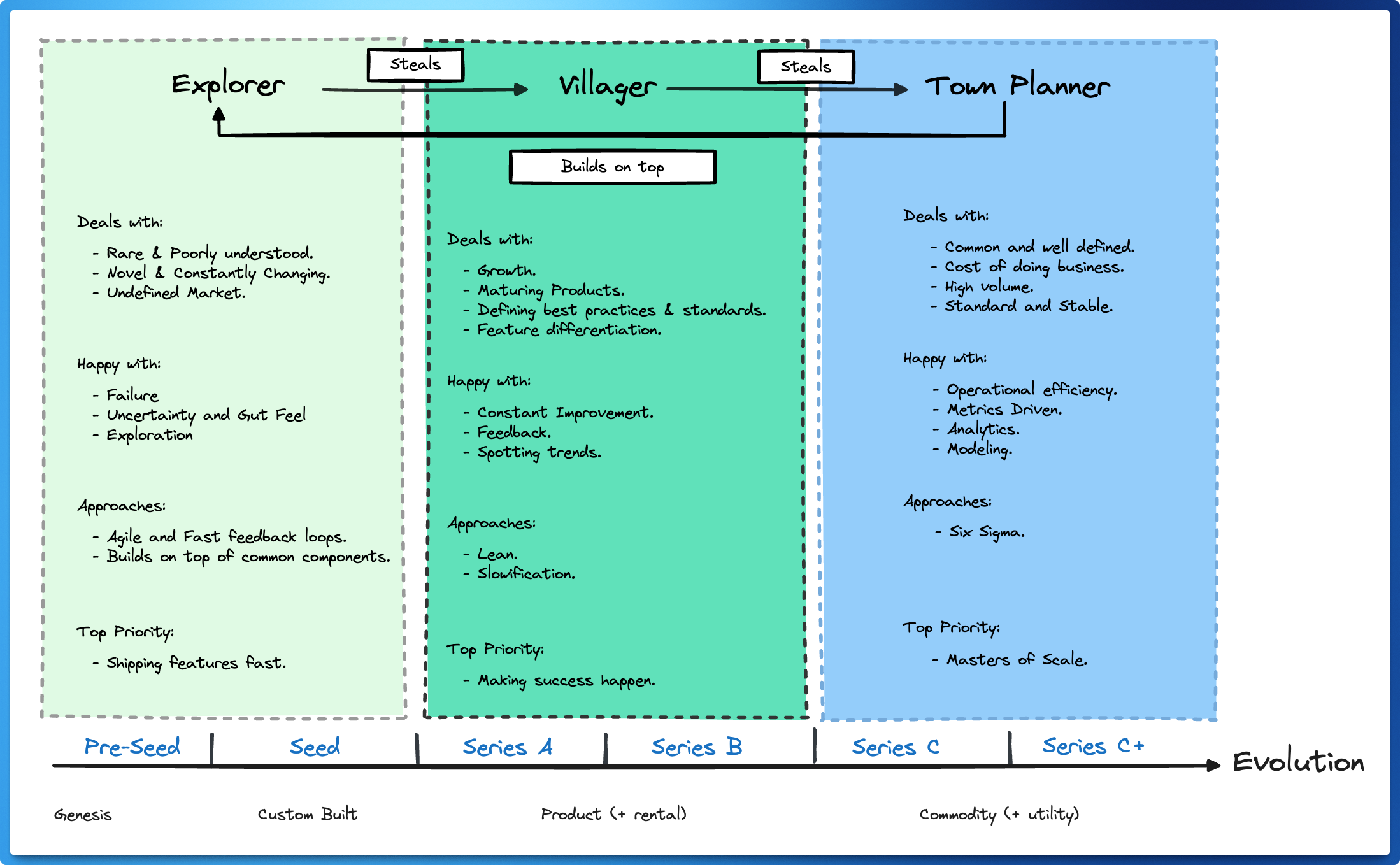
Software Engineers as Explorers are venturing to discover a market opportunity. They value scrappiness, adaptability and speed of prototyping features over anything else.
They feel comfortable with ambiguity and risk. There’s not a lot of time for best practices, architectural reviews, or ceremonies until they get to an MVP.
Software Engineers as Villagers shift their attention to building a good foundation as the startup gains traction (and secures funding). Engineers need to establish core practices, infrastructure and a strong team to support growth. The name of the game is refining product-market fit while still moving quickly by shipping features continuously.
Code reviews (PRs), testing practices, architectural reviews (like RFCs and Six Pagers), and other ceremonies are formalized. The focus is creating structure and stability while maintaining flexibility to adapt as the company grows. The engineering organization starts to grow too. There is space for Tech Leads and even opportunities to experiment managing other engineers. Engineers start to think about operational procedures, metrics and alarms.
Software Engineers as Town Planners focus on optimizing for scale. This is a completely different game where the goal is long-term success. The engineering organization has to address complexity, and wants to make sure every engineer is building robust, scalable systems with a very strong emphasis on performance, security and maintainability.
Engineers start to specialize into specific domains, like machine learning, data or infra, or into niche areas of the business. They care about operational efficiency, data driven experimentation, and optimizing cost, latency and performance.